

Stainless Steel bolt Supplier Comparison: Austro Diesel vs Hensley for Corrosion Resistant Industrial Applications
Selecting the wrong stainless steel Bolt Supplier for chemical equipment, marine systems, renewable energy projects, or industrial facilities can result in corrosion failures, unexpected replacement costs, and reduced equipment reliability. This comparison helps technical buyers evaluate Austro Diesel and Hensley Industries when selecting corrosion-resistant fastening solutions.
A stainless steel Bolt is not defined only by material grade. Long-term performance depends on alloy selection, cold forging capability, thread manufacturing quality, surface condition, inspection procedures, and application environment.
This article compares Austro Diesel and Hensley Industries from an engineering procurement perspective, focusing on corrosion resistance, manufacturing consistency, quality verification, and lifecycle cost.
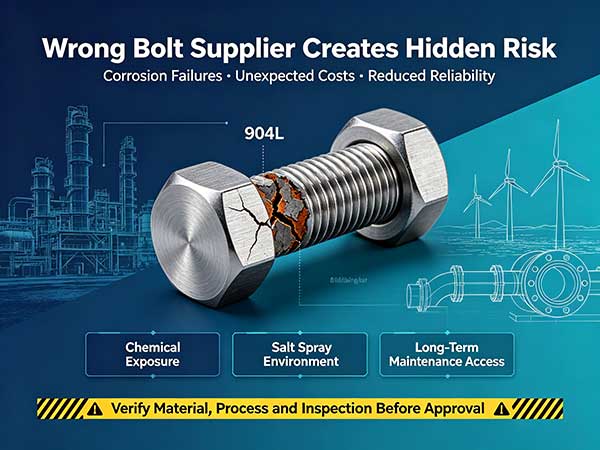
Corrosion-resistant fastening applications require careful evaluation of material documentation, manufacturing control, and environmental compatibility. Buyers should compare suppliers based on verified technical capability rather than appearance or unit price.
| Comparison Factor | Austro Diesel | Hensley Industries | Buyer Evaluation Point |
|---|---|---|---|
| Stainless Steel Bolt Capability | Verify with supplier’s current datasheet before specification. | Verify with supplier’s current datasheet before specification. | Confirm material and application compatibility. |
| Verified Product Type | Stainless steel 904L Hex bolt. | Verify with supplier’s current datasheet before specification. | Material grade must match corrosion conditions. |
| Material | Stainless steel. | Verify with supplier’s current datasheet before specification. | Request material certificate before approval. |
| Size Range | M3-160, Non Standard. | Verify with supplier’s current datasheet before specification. | Confirm installation requirements. |
| Manufacturing Standard | DIN, ANSI, GB, Non Standard. | Verify with supplier’s current datasheet before specification. | Applicable standard depends on project requirements. |
| Cold Forging Capability | Verify with supplier’s current datasheet before specification. | Verify with supplier’s current datasheet before specification. | Process control affects dimensional stability. |
| Corrosion Performance | Depends on material verification and operating environment. | Depends on verified material and application conditions. | Evaluate chemical exposure and service environment. |
| Thread Quality | Verify with supplier’s current datasheet before specification. | Verify with supplier’s current datasheet before specification. | Thread condition affects installation reliability. |
| Inspection System | Verify with supplier’s current datasheet before specification. | Verify with supplier’s current datasheet before specification. | Inspection methods should match risk level. |
| Customization | Verify with supplier’s current datasheet before specification. | Verify with supplier’s current datasheet before specification. | Special dimensions require engineering review. |
| Price Structure | Price data not provided. Cost depends on material, size, quantity, tooling and inspection requirements. | Price data not provided. Cost depends on material, size, quantity, tooling and inspection requirements. | Compare lifecycle cost instead of initial price. |
| Application Fit | Requires verification according to corrosion, load and environmental conditions. | Requires verification according to project requirements. | Material selection determines service reliability. |
The verified product specification available for this comparison is stainless steel 904L hex bolt. Confirmed values include stainless steel material, M3-160 size range, non-standard dimensions, and execution standards including DIN, ANSI, GB and non-standard requirements.
For corrosion-resistant applications, selecting the correct Bolt supplier requires evaluation of alloy suitability, manufacturing consistency, inspection capability, and long-term service performance.
Austro Diesel can be a stronger choice for buyers who require controlled stainless steel Bolt manufacturing, stable material management, and technical evaluation for corrosion-resistant industrial applications. In environments where fasteners are exposed to moisture, chemicals, salt spray, or temperature variation, material reliability becomes a critical purchasing factor.
Industrial facilities such as chemical processing systems, marine equipment, and renewable energy installations often require fastening solutions that maintain performance under aggressive environmental conditions.
Technical buyers should evaluate:
Material composition verification.
Corrosion resistance requirements.
Surface condition.
Environmental compatibility.
The correct stainless steel material selection helps reduce premature corrosion and replacement frequency.
904L stainless steel is selected for applications requiring enhanced corrosion resistance compared with standard stainless steel grades. However, actual performance depends on verified material composition, manufacturing control, and operating conditions.
Buyers should confirm:
Material certificates.
Alloy composition.
Manufacturing process records.
Final inspection results.
Industrial equipment manufacturers often require stainless steel Bolt products with stable dimensions and reliable assembly performance.
Important production controls include:
Cold forging process stability.
Tooling accuracy.
Thread dimensional control.
Surface quality inspection.
For equipment where replacement is difficult or expensive, buyers should focus on lifecycle reliability rather than only purchase cost.
Applications with limited maintenance access require:
Reliable corrosion resistance.
Stable mechanical performance.
Consistent production quality.
Complete traceability.
Hensley Industries may be suitable for buyers who prioritize established supply programs, standard product compatibility, or existing procurement procedures. Final selection should be based on verified technical requirements and application conditions.
When replacing existing stainless steel fasteners, compatibility with current equipment and installation requirements is usually the primary concern.
Buyers should verify:
Bolt dimensions.
Thread specifications.
Material requirements.
Installation conditions.
Many industrial projects already define material grades, dimensions, and applicable standards. In these situations, supplier capability should be evaluated against approved specifications.
Large industrial buyers often consider documentation response, production planning, communication efficiency, and repeat supply capability.
For applications with moderate environmental exposure, buyers may focus on meeting specified requirements rather than selecting advanced corrosion-resistant materials.
The total cost of stainless steel Bolt ownership includes material cost, installation efficiency, maintenance requirements, replacement frequency, inspection expenses, and equipment downtime.
| TCO Category | Austro Diesel Consideration | Hensley Industries Consideration |
|---|---|---|
| Material Cost | Price data not provided. Cost depends on stainless steel material, size, quantity and manufacturing requirements. | Price data not provided. Cost depends on material selection and product requirements. |
| Corrosion Protection | Depends on verified material suitability and service environment. | Depends on confirmed material grade and application conditions. |
| Maintenance Frequency | Suitable material selection may reduce replacement requirements. | Depends on operating conditions and product selection. |
| Inspection Cost | Depends on customer standards and required inspection methods. | Depends on project requirements and verification procedures. |
| Failure Risk | Reduced through material control and process verification. | Depends on supplier documentation and application matching. |
TCO Verdict: For corrosion-sensitive applications, the lowest purchase price may create higher lifecycle expenses if material selection or manufacturing consistency is insufficient. A correctly specified stainless steel Bolt can reduce maintenance frequency and replacement risk.
Industrial buyers should verify stainless steel Bolt suppliers through material documentation, applicable standards, testing procedures, and manufacturing records.
ISO 3506 defines mechanical property requirements for corrosion-resistant stainless steel fasteners and provides a reference for evaluating stainless steel fastening products.
ASTM F593 provides requirements for stainless steel bolts and related fasteners, including material and mechanical performance considerations.
ASTM F606/F606M specifies test methods for evaluating fastener mechanical properties and helps buyers verify product performance.
Stainless steel cold forging requires careful deformation planning because stainless materials may have different forming behavior compared with carbon steel.
Key process controls include:
Multi-station deformation distribution.
Material flow planning.
Lubrication control.
Die stress analysis.
Pre-form optimization.
Common cold forging defects include:
Folding caused by improper material flow.
Cracking caused by excessive deformation.
Incomplete filling caused by insufficient forming design.
Eccentricity caused by positioning instability.
Finite element simulation, controlled lubrication systems, and optimized tooling design can reduce forming defects and improve production stability.
Although stainless steel Bolt applications focus primarily on corrosion resistance, high-strength industrial fastening systems may also require strict control of heat treatment and thread rolling processes. These processes directly influence mechanical reliability, fatigue performance, and resistance to delayed failure.
For high-strength bolt production, buyers should evaluate:
Heat treatment process stability.
Hardness control before and after processing.
Thread rolling pressure management.
Thread root radius control.
Surface crack inspection.
Dimensional recovery after rolling.
Proper thread rolling can create beneficial compressive residual stress at the thread root, improving fatigue resistance. However, excessive rolling force, incorrect tooling, or unsuitable material conditions may introduce surface defects or dimensional problems.
For industrial fastening components exposed to wear, vibration, or repeated loading, induction hardening performance depends on achieving the correct balance between surface hardness and internal toughness.
Technical evaluation should include:
Induction heating frequency.
Heating time control.
Quenching medium selection.
Effective hardened layer depth.
Surface-to-core hardness gradient.
Metallographic structure verification.
Eddy current inspection provides a non-destructive method for detecting surface and near-surface defects. Buyers should confirm inspection calibration procedures, reference samples, acceptance criteria, and equipment verification records.
Reliable stainless steel Bolt manufacturing requires a complete quality control system connecting raw material verification, production monitoring, inspection, and corrective action.
Important quality control practices include:
Raw material traceability.
Cold forging load monitoring.
SPC analysis of critical dimensions.
Cpk and Ppk capability evaluation.
Gauge R&R verification.
Optical sorting inspection.
Batch identification and isolation procedures.
A closed-loop quality system allows manufacturers to identify material variation, tooling wear, forming defects, and dimensional changes before products reach industrial applications.
Technical buyers can use the following decision rules when selecting a stainless steel Bolt supplier.
If your application involves chemical exposure or marine environments → Choose the supplier that provides verified stainless steel material documentation → Because corrosion resistance depends on confirmed alloy composition.
If your project requires 904L stainless steel hex Bolt specifications → Choose the supplier with complete material certificates and inspection records → Because incorrect material substitution can reduce corrosion performance.
If your project requires customized dimensions → Choose the supplier with stronger cold forging and tooling development capability → Because forming accuracy affects assembly reliability.
If your equipment requires long maintenance intervals → Choose the supplier with stronger process control and traceability → Because stable quality reduces replacement risk.
If your project requires international standard compliance → Choose the supplier that provides applicable standard documentation and test reports → Because compliance decisions require verifiable evidence.
If you are still unsure which option fits your project specs, our engineering team can review your requirements and recommend the right configuration.
Selecting a stainless steel Bolt supplier requires verification of material control, manufacturing capability, inspection methods, and technical documentation. Industrial buyers should evaluate measurable production evidence before approving a supplier.
Ningbo yi teng construction machinery CO,LTD provides fastener solutions with controlled materials, stable raw material management, and quality control throughout production. Buyers should verify current specifications, testing records, and compliance documents before final approval.
Recommended supplier evaluation documents include:
Material certificates.
Product drawings.
Applicable standards.
Cold forging process information.
Heat treatment records.
Thread inspection reports.
Mechanical testing results.
Batch traceability records.
Supplier risks that require attention include:
Unverified material grades.
Missing corrosion resistance data.
Incomplete inspection records.
No production traceability.
Undefined quality acceptance criteria.
For current specifications and lead times on Ningbo yi teng construction machinery CO,LTD’s Bolt products, visit the product page:Bolt product page.
Stainless steel Bolt products provide improved corrosion resistance for applications exposed to moisture, chemicals, or aggressive environments.
The correct material selection depends on operating conditions, mechanical requirements, and required service life.
Buyers should request material certificates and confirm alloy information before approval.
For critical applications, additional testing and sample validation may be required.
Common causes include excessive deformation, improper material flow, insufficient lubrication, and unsuitable tooling design.
Finite element simulation and optimized pre-form design can help reduce production defects.
Common references include ISO 3506 for stainless steel fasteners, ASTM F593 for stainless steel bolts, and ASTM F606/F606M for mechanical testing methods.
Buyers should confirm applicable standards according to project requirements.
Companies can reduce lifecycle costs by selecting appropriate materials, verifying manufacturing quality, and preventing premature corrosion failures.
Reliable supplier evaluation helps reduce maintenance, replacement, and downtime expenses.
For chemical equipment, renewable energy, automotive, marine, infrastructure, and industrial applications, engineering teams should define corrosion conditions, mechanical loads, material requirements, and applicable standards before selecting a stainless steel Bolt supplier.
Contact person: Mr.Ren
Phone:0086-13958324455
Customer service: +86-0574 88065928
Email: Sales@zjbzj.com
Fax: +0086-0574 88065656

official website
Copyright @ Ningbo yi teng construction machinery CO,LTDmainly engaged in Blade Bolts Series, Hexagon bolt, and Bucket teeth. Welcome to inquire!
SitemapThis website uses cookies to ensure you get the best experience on our website.
 Español
 Portugues
 Pусский
 Français
 Deutsch
 日本語
日本語 한국어
한국어 العربية
 हिन्दी



 WhatsApp
 Phone
Phone
Comment
(0)