
 Español
 Portugues
 Pусский
 Français
 Deutsch
 日本語
日本語 한국어
한국어 العربية
 हिन्दी
Phosphated stud
A phosphated stud is a type of threaded fastener that has undergone a phosphate conversion coating process to improve its surface properties, performance, and durability. It is commonly used in mechanical assembly, automotive systems, construction equipment, machinery, and many other industrial applications where reliable fastening is required. The phosphate coating gives the stud a dark gray or black appearance and provides a protective layer that helps resist corrosion, reduces friction, and improves paint or lubricant adhesion.A stud is typically a rod with external threads on one or both ends, or along its full length, depending on the design. Compared with ordinary uncoated studs, a phosphated stud offers better surface protection and more stable handling during assembly. The phosphating process creates a thin, crystalline layer on the metal surface, which is usually made from zinc phosphate or manganese phosphate. This layer does not significantly change the size of the stud, but it does enhance surface performance and contributes to longer service life in demanding environments.One of the main advantages of a phosphated stud is its improved resistance to wear and corrosion. While phosphate coating alone is not as protective as some thicker coatings, it works very well when combined with oiling, sealing, or other post-treatment methods. In many industrial applications, phosphated studs are chosen because they provide a good balance between cost, performance, and ease of use. The coating also helps reduce the risk of galling during installation, especially when the stud is tightened into metal components under high load.Phosphated studs are often used where fast assembly and dependable torque performance are important. The coating allows the threads to engage more smoothly, which can help achieve more consistent tightening results. This is especially valuable in engine parts, transmission assemblies, heavy equipment, and structural connections. In addition, phosphate-treated surfaces can hold lubricants well, making them suitable for applications where repeated contact, vibration, or heat may occur.The manufacturing process for a phosphated stud usually begins with material selection, such as carbon steel or alloy steel, depending on strength requirements. The stud is then machined or cold-formed to the required dimensions before being cleaned and phosphated. After the phosphate layer is formed, the part may be rinsed, dried, and treated with oil or another protective finish. Quality control checks are performed to ensure thread accuracy, coating uniformity, and mechanical strength.Phosphated studs are valued for their practical performance, simple appearance, and versatility. They are widely used in situations where a strong, economical, and moderately corrosion-resistant fastener is needed. Although they are not intended for highly decorative applications, they remain an important choice in engineering and industrial fastening because of their reliability and functional benefits.
Products
Category:
-
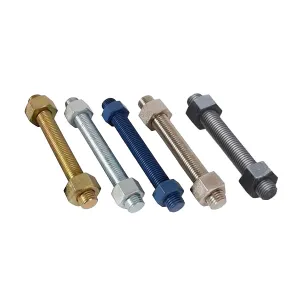
Studs b7
Category: Studs b7Browse number: 268Number:Release time: 2026-07-21 11:48:08Port:Port NINGBO Payment Terms:L/C,D/A,D/P,T/T
News
Category:
No search results found!
Case
Category:
No search results found!
Video
Category:
No search results found!
Download
Category:
No search results found!
Job
Category:
No search results found!
Featured Products
No search results found!



 WhatsApp
 Phone
Phone