

Stainless Steel 904L Hex bolt Supplier Comparison: Austro Diesel vs Hensley for Corrosion Resistant Applications
Selecting an unsuitable corrosion-resistant Bolt for chemical equipment, outdoor infrastructure, or demanding industrial environments can create expensive failures caused by corrosion damage, joint loosening, maintenance interruptions, and premature replacement. This comparison helps technical buyers evaluate Austro Diesel and Hensley Industries when selecting stainless steel Bolt solutions for challenging applications.
A corrosion-resistant Bolt requires more than selecting stainless steel material. Engineers must evaluate material stability, manufacturing quality, dimensional accuracy, thread performance, surface condition, and inspection capability before approving a supplier.
This article compares Austro Diesel and Hensley Industries from a technical procurement perspective, focusing on stainless steel 904L Hex bolt applications, manufacturing risks, quality control, and lifecycle cost.
Stainless steel Bolt selection requires evaluating both material performance and manufacturing consistency. Even corrosion-resistant materials can fail if forming defects, thread damage, or dimensional problems affect joint reliability.
| Comparison Factor | Austro Diesel | Hensley Industries | Buyer Evaluation Point |
|---|---|---|---|
| Stainless Steel Bolt Capability | Verify with supplier’s current datasheet before specification. | Verify with supplier’s current datasheet before specification. | Confirm material grade and application suitability. |
| 904L Stainless Steel Bolt Specification | Verify with supplier’s current datasheet before specification. | Verify with supplier’s current datasheet before specification. | Material certificates should be reviewed before approval. |
| Verified Product Material | Stainless steel | Verify with supplier’s current datasheet before specification. | Material composition should match environmental requirements. |
| Verified Product Size | M3-160, Non Standard | Verify with supplier’s current datasheet before specification. | Confirm dimensional compatibility with assembly design. |
| Execution Standards | DIN, ANSI, GB, Non Standard | Verify with supplier’s current datasheet before specification. | Applicable standards should match project requirements. |
| Cold Heading Process | Verify with supplier’s current datasheet before specification. | Verify with supplier’s current datasheet before specification. | Forming control affects defects and consistency. |
| Thread Quality | Verify with supplier’s current datasheet before specification. | Verify with supplier’s current datasheet before specification. | Thread condition affects installation reliability. |
| Corrosion Resistance | Depends on verified material properties and environment. | Depends on verified material properties and environment. | Application environment must be evaluated. |
| Customization | Verify with supplier’s current datasheet before specification. | Verify with supplier’s current datasheet before specification. | Non-standard designs require engineering confirmation. |
| Inspection Capability | Verify with supplier’s current datasheet before specification. | Verify with supplier’s current datasheet before specification. | Inspection methods should match product risk. |
| Price Structure | Price data not provided. Cost depends on material grade, size, volume, tooling and inspection requirements. | Price data not provided. Cost depends on material grade, size, volume, tooling and inspection requirements. | Material cost and lifecycle value should be considered. |
| Application Fit | Requires verification according to corrosion exposure and mechanical load. | Requires verification according to corrosion exposure and mechanical load. | Select based on operating environment. |
The verified specification available for this comparison is stainless steel 904l hex bolt. Confirmed values include stainless steel material, size range M3-160 and non-standard dimensions, with execution standards including DIN, ANSI, GB and non-standard requirements.
For corrosion-sensitive applications, Bolt selection should consider the complete engineering environment, including chemical exposure, temperature variation, mechanical loading, and maintenance requirements.
Austro Diesel can be a stronger choice for buyers who require Industrial Bolt solutions with controlled material management, manufacturing consistency, and application-focused evaluation. For corrosion-resistant fasteners, supplier capability must be assessed through material control, forming quality, and inspection reliability.
Stainless steel 904L Bolt applications are commonly associated with demanding environments where corrosion resistance is a primary concern. These environments may include chemical processing equipment, marine conditions, outdoor structures, and industrial facilities exposed to aggressive media.
The selection process should consider:
Material composition verification.
Environmental corrosion factors.
Temperature conditions.
Mechanical loading requirements.
Material selection alone is not sufficient. Manufacturing defects, surface damage, or improper installation can reduce corrosion performance.
Many industrial applications require customized Bolt dimensions due to special equipment structures, limited installation space, or unique connection designs.
Custom stainless steel Bolt production requires evaluation of:
Cold forming feasibility.
Material flow behavior.
Tooling design.
Dimensional validation.
A controlled engineering process reduces risks such as incomplete forming, dimensional deviation, and thread problems.
For critical equipment, fastener failure can cause expensive maintenance events or operational interruption. Buyers should evaluate suppliers that provide stable manufacturing processes and clear quality documentation.
Important controls include:
Raw material traceability.
Batch inspection.
Dimensional control.
Mechanical testing.
Technical purchasing teams increasingly require suppliers to explain how manufacturing risks are controlled.
For stainless steel Bolt production, suppliers should be able to explain:
Material receiving inspection.
Cold heading process parameters.
Thread manufacturing methods.
Surface quality control.
Final inspection procedures.
Hensley Industries may provide advantages for buyers who prioritize existing supply relationships, application compatibility, or established procurement procedures. Technical verification remains necessary before approving any stainless steel Bolt Supplier.
When replacing fasteners in existing systems, maintaining original engineering compatibility is often more important than selecting a different product design.
Buyers should confirm:
Thread dimensions.
Bolt size requirements.
Material specifications.
Assembly conditions.
Companies operating multiple facilities may prefer standardized fastener programs to simplify inventory management and maintenance operations.
Supplier consistency, documentation availability, and repeat ordering capability become important selection factors.
When engineering teams already specify required materials and standards, supplier evaluation may focus on compliance, documentation, and supply capability.
Large buyers often evaluate suppliers based on communication efficiency, documentation response, logistics coordination, and production planning.
A complete procurement evaluation should include both technical and operational factors.
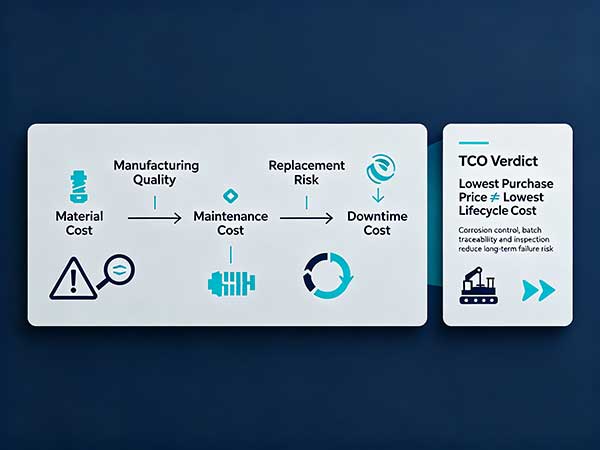
The TCO of stainless steel Bolt products should include material cost, manufacturing quality, maintenance requirements, replacement risk, and environmental service conditions.
| TCO Factor | Austro Diesel Consideration | Hensley Industries Consideration |
|---|---|---|
| Material Cost | Price depends on stainless steel grade, size, quantity and specification requirements. | Price depends on material selection and application requirements. |
| Corrosion Protection Value | Appropriate stainless steel selection can reduce replacement frequency in corrosive environments. | Verify material suitability before approval. |
| Manufacturing Quality Cost | Process control can reduce defect-related losses. | Verify manufacturing quality procedures. |
| Maintenance Cost | Depends on operating environment and installation conditions. | Depends on application requirements. |
| Replacement Risk | Reduced through proper material verification and quality control. | Depends on product matching and inspection procedures. |
TCO Verdict: For corrosion-resistant Bolt applications, the most economical choice is not always the lowest purchase price. A correctly selected stainless steel solution can reduce maintenance frequency, replacement costs, and operational disruption over the product lifecycle.
Stainless steel Bolt buyers should verify material documentation, dimensional standards, mechanical requirements, and inspection procedures before supplier approval.
ISO 3506 defines mechanical property requirements for stainless steel fasteners and provides guidance for selecting appropriate stainless steel grades.
ASTM F593 provides requirements for stainless steel bolts and related fasteners, including material and mechanical performance considerations.
DIN 933 provides dimensional references for fully threaded hexagon head screws used in industrial fastening applications.
Stainless steel materials generally have different forming characteristics compared with carbon steel materials. Cold heading process design must consider material flow, deformation resistance, and tooling stress.
Potential defects include:
Folding caused by unstable material flow.
Cracking caused by excessive deformation.
Incomplete filling caused by unsuitable preforming.
Dimensional deviation caused by tooling wear.
Effective control methods include:
Finite element simulation for forming analysis.
Optimized station deformation distribution.
Phosphating lubrication control.
Annealing processes to improve material formability.
For stainless steel Bolt production, thread quality directly affects assembly performance and long-term reliability.
Engineers should verify:
Thread dimensional accuracy.
Surface defect inspection.
Rolling process stability.
Tool wear monitoring.
Although stainless steel 904L Bolt applications mainly focus on corrosion resistance, some industrial fastening components may also require surface treatment or localized hardening processes depending on mechanical requirements. In these cases, process control must consider hardened layer depth, hardness distribution, and metallurgical stability.
Engineering buyers should request verification information including:
Surface hardness requirements.
Core hardness requirements.
Metallographic inspection results.
Heat treatment process records.
Eddy current inspection procedures.
Eddy current inspection provides a non-destructive method for identifying surface and near-surface defects. The effectiveness of the inspection system depends on calibration procedures, reference samples, acceptance criteria, and equipment verification frequency.
A reliable stainless steel Bolt supplier should operate a complete quality control system that connects incoming material inspection, manufacturing monitoring, final inspection, and traceability management.
Important quality control practices include:
Raw material verification before production.
Cold heading process monitoring.
Thread inspection during production.
Dimensional measurement and statistical analysis.
Optical sorting for defect separation.
Batch traceability and abnormal product isolation.
For corrosion-resistant applications, preventing defects during manufacturing is essential because surface damage or dimensional problems may reduce long-term reliability.
The following decision rules help technical buyers select the appropriate stainless steel Bolt supplier.
If your application involves chemical exposure or marine environments → Choose the supplier that provides verified stainless steel material documentation → Because corrosion resistance depends on confirmed material composition.
If your project requires stainless steel 904L hex Bolt with M3-160 dimensions → Choose the supplier that can provide current drawings and dimensional verification → Because non-standard requirements require precise engineering matching.
If your equipment requires customized stainless steel fasteners → Choose the supplier with stronger cold forming engineering capability → Because forming design affects defects, dimensional accuracy, and production consistency.
If your application requires long service life with minimum maintenance → Choose the supplier with stronger inspection and traceability systems → Because preventing early failures reduces replacement and downtime costs.
If your procurement team requires compliance documentation → Choose the supplier that provides complete standards, testing, and material records → Because documentation supports quality approval and project acceptance.
If you are still unsure which option fits your project specs, our engineering team can review your requirements and recommend the right configuration.
A reliable stainless steel Bolt supplier should demonstrate control over materials, manufacturing processes, inspection systems, and documentation management. Supplier evaluation should focus on technical evidence rather than only product descriptions.
Ningbo yi teng construction machinery CO,LTD provides fastener solutions with controlled materials, stable raw material management, and quality control throughout production. Buyers should verify current specifications, inspection reports, and compliance documents before final approval.
Before purchasing stainless steel Bolt products, engineering teams should request:
Material certificates for stainless steel grades.
Product drawings and dimensional specifications.
Manufacturing process information.
Mechanical test records.
Surface inspection reports.
Batch traceability documentation.
Sample validation results.
Supplier risks that should be reviewed include:
Unverified material sources.
Missing corrosion-related documentation.
Unclear manufacturing processes.
Incomplete inspection procedures.
Inconsistent product dimensions.
For current specifications and lead times on Ningbo yi teng construction machinery CO,LTD’s stainless steel Bolt products, visit the product page:Bolt product page.
Stainless steel 904L Bolt products are selected for applications where corrosion resistance is a major requirement. The correct material choice can improve service reliability in aggressive environments.
However, buyers should verify actual material documentation and confirm suitability according to operating conditions.
Buyers should check material certificates, dimensional accuracy, applicable standards, mechanical requirements, and inspection procedures.
For critical applications, sample testing and production validation should be completed before mass purchasing.
Cold heading affects material flow, dimensional consistency, and defect risk during Bolt production. Stainless steel materials require careful forming control because deformation behavior differs from standard carbon steel.
Proper tooling design, lubrication control, and process monitoring help prevent folding, cracking, and incomplete forming.
Companies can reduce lifecycle costs by selecting appropriate materials, verifying supplier quality systems, and preventing premature replacement caused by corrosion or manufacturing defects.
A higher initial material cost may provide better long-term value when it reduces maintenance frequency and downtime.
Important inspection methods include dimensional measurement, material verification, surface inspection, mechanical testing, and traceability control.
For high-risk applications, suppliers should also demonstrate defect detection methods and quality acceptance criteria.
For automotive, construction machinery, and industrial projects requiring stainless steel Bolt solutions, engineering teams should prepare application conditions, drawings, material requirements, and relevant standards before supplier evaluation.
Contact person: Ms.Ren
Phone:0086-13958324455
Customer service: +86-0574 88065928
Email: Sales@zjbzj.com
Fax: +0086-0574 88065656

official website
Copyright @ Ningbo yi teng construction machinery CO,LTDmainly engaged in Blade Bolts Series, Hexagon bolt, and Bucket teeth. Welcome to inquire!
SitemapThis website uses cookies to ensure you get the best experience on our website.
 Español
 Portugues
 Pусский
 Français
 Deutsch
 日本語
日本語 한국어
한국어 العربية
 हिन्दी



 WhatsApp
 Phone
Phone
Comment
(0)