

Cold Forged bolt Manufacturing Comparison: Austro Diesel vs Hensley for Precision fastener Production
Choosing the wrong cold forged Bolt Supplier can create hidden manufacturing costs through inconsistent dimensions, forming defects, assembly problems, and unexpected field failures. This comparison helps technical buyers evaluate Austro Diesel and Hensley Industries when selecting Precision fasteners for automotive systems, construction machinery, infrastructure projects, and industrial equipment.
Cold forging is not only a production method but also a quality control challenge. The final performance of a Bolt depends on raw material stability, multi-station forming design, material flow control, tooling condition, heat treatment, and inspection capability.
This article compares the two suppliers from an engineering procurement perspective, focusing on cold heading capability, defect prevention, manufacturing reliability, and total cost of ownership.
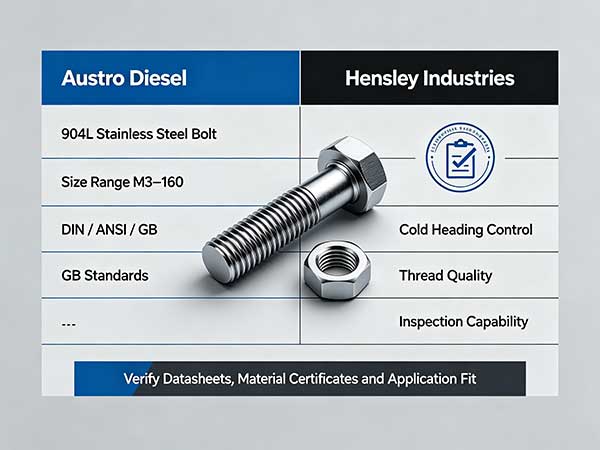
For Industrial Bolt applications, buyers should evaluate how suppliers control the complete manufacturing process. A stable cold forging system can improve material utilization, production consistency, and long-term fastening reliability.
| Comparison Factor | Austro Diesel | Hensley Industries | Buyer Evaluation Point |
|---|---|---|---|
| Cold Forged Bolt Capability | Verify with supplier’s current datasheet before specification. | Verify with supplier’s current datasheet before specification. | Confirm forming capability according to product requirements. |
| Multi-Station Cold Heading | Verify with supplier’s current datasheet before specification. | Verify with supplier’s current datasheet before specification. | Evaluate deformation planning and tooling control. |
| Material Control | Verify with supplier’s current datasheet before specification. | Verify with supplier’s current datasheet before specification. | Stable materials reduce production variation. |
| Forming Defect Control | Verify with supplier’s current datasheet before specification. | Verify with supplier’s current datasheet before specification. | Review prevention methods for folding and cracking. |
| Tooling Management | Verify with supplier’s current datasheet before specification. | Verify with supplier’s current datasheet before specification. | Tool wear affects dimensional stability. |
| Thread Manufacturing | Verify with supplier’s current datasheet before specification. | Verify with supplier’s current datasheet before specification. | Thread quality affects assembly performance. |
| Quality Inspection | Verify with supplier’s current datasheet before specification. | Verify with supplier’s current datasheet before specification. | Inspection methods should match product risk. |
| Customization Capability | Verify with supplier’s current datasheet before specification. | Verify with supplier’s current datasheet before specification. | Special designs require engineering validation. |
| Production Efficiency | Depends on equipment capability, tooling design and production conditions. | Depends on equipment capability and production requirements. | Evaluate production stability rather than only output speed. |
| Price Structure | Price data not provided. Cost depends on material, size, quantity, tooling and inspection requirements. | Price data not provided. Cost depends on material, size, quantity, tooling and inspection requirements. | Compare lifecycle cost instead of unit price only. |
| Application Fit | Requires verification according to load, environment and assembly requirements. | Requires verification according to application requirements. | Select based on engineering conditions. |
The verified product specification available for this comparison is stainless steel 904l Hex bolt. Confirmed values include stainless steel material, M3-160 size range and non-standard dimensions, with execution standards including DIN, ANSI, GB and non-standard requirements.
For precision Bolt manufacturing, the supplier’s cold forging process capability is often a decisive factor because defects created during forming may affect later machining, heat treatment, assembly, and service performance.
Austro Diesel can be a stronger choice for buyers who require stable cold forged Bolt production, controlled material flow, and engineering-focused manufacturing evaluation. In precision fastening applications, production consistency often determines the final reliability of the assembled product.
Automotive manufacturers, construction machinery producers, and industrial equipment companies often require large quantities of identical fasteners. Small variations in Bolt geometry can create assembly problems, installation delays, and additional inspection requirements.
A strong cold forging process should control:
Raw material consistency.
Forming sequence design.
Tooling wear conditions.
Dimensional stability.
Stable production reduces variation between batches and improves manufacturing efficiency.
Multi-station cold heading requires precise planning of deformation distribution. Each forming station must complete a controlled amount of material movement to avoid excessive stress concentration.
Technical evaluation should include:
Station-by-station deformation design.
Upsetting ratio calculation.
Material flow analysis.
Die stress evaluation.
Incorrect forming design can create folding, cracking, eccentricity, and incomplete filling defects.
For industrial fasteners, preventing defects during manufacturing is more effective than detecting failures after production.
Important prevention methods include:
Finite element simulation before tooling production.
Pre-form optimization.
Phosphating lubrication control.
Annealing process management.
Cold forging can reduce material waste compared with traditional machining processes because the material is formed into the required geometry rather than removing large amounts of material.
However, material savings depend on correct process design and stable production control.
Hensley Industries may provide advantages for customers who prioritize established supply relationships, existing product compatibility, or defined procurement procedures. Buyers should confirm technical specifications before selecting a supplier.
When replacing existing Bolt products, engineering teams often prioritize dimensional compatibility and installation consistency.
Verification should include:
Thread specifications.
Material requirements.
Mechanical performance requirements.
Assembly conditions.
Some industrial projects already have approved drawings and technical requirements. In these cases, supplier evaluation focuses on meeting documented specifications.
Large buyers often consider procurement efficiency, documentation response, logistics coordination, and production planning when evaluating suppliers.
A supplier capable of supporting repeat purchasing programs can reduce internal procurement workload.
For standard applications, buyers may focus on compliance with existing requirements rather than develoPing new manufacturing solutions.
The TCO of cold forged Bolt products includes raw material usage, tooling cost, production stability, inspection requirements, replacement risk, and operational impact.
| TCO Category | Austro Diesel Consideration | Hensley Industries Consideration |
|---|---|---|
| Material Utilization | Cold forging efficiency depends on forming design and process control. | Verify manufacturing method and material utilization capability. |
| Tooling Cost | Depends on forming complexity, die design and production volume. | Depends on product requirements and tooling conditions. |
| Production Stability | Improved through controlled forming processes and monitoring. | Depends on manufacturing capability verification. |
| Inspection Cost | Depends on quality requirements and inspection methods. | Depends on application requirements and customer standards. |
| Failure Cost | Reduced through defect prevention and process control. | Depends on product matching and quality verification. |
TCO Verdict: For precision cold forged Bolt applications, the lowest purchase price does not always represent the lowest total cost. A stable forming process can reduce material waste, inspection failures, production interruptions, and replacement expenses throughout the product lifecycle.
Cold forged Bolt buyers should evaluate suppliers according to manufacturing standards, material requirements, testing procedures, and documented quality control methods.
ISO 898-1:2013 defines mechanical property requirements for steel fasteners and provides testing references for strength classification.
ISO 3506 provides requirements for corrosion-resistant stainless steel fasteners, including mechanical property evaluation.
ASTM F606/F606M defines test methods used to evaluate fastener mechanical performance, including tensile and hardness-related testing.
A reliable cold forging process requires accurate deformation planning between different forming stations.
Engineers should evaluate:
Material flow direction.
Reduction ratio between stages.
Pre-form geometry.
Tool loading conditions.
Typical cold forging defects include:
Folding caused by incorrect material movement.
Cracking caused by excessive local stress.
Incomplete filling caused by insufficient material distribution.
Eccentric forming caused by positioning errors.
Defect prevention methods include finite element simulation, optimized tooling design, controlled lubrication systems, and continuous production monitoring.
Thread rolling performance directly affects Bolt assembly reliability. Buyers should verify thread dimensions, surface condition, rolling stability, and inspection methods.
For High-strength fasteners, thread rolling after heat treatment requires additional control because higher hardness increases the risk of surface cracking and tool wear.
Some industrial Bolt applications require additional surface performance through heat treatment processes such as induction hardening. The effectiveness of this process depends on controlling the relationship between surface hardness, hardened layer depth, and internal toughness.
Before approving a supplier, technical buyers should verify:
Heating frequency and process parameters.
Heating time and temperature control.
Quenching method.
Effective hardened layer depth.
Surface and core hardness requirements.
Metallographic structure inspection.
Eddy current inspection provides a non-destructive method for detecting surface and near-surface defects. A qualified inspection system requires calibration standards, reference defect samples, acceptance criteria, and regular equipment verification.
Modern cold forged Bolt production requires a complete quality feedback system that connects manufacturing data, process analysis, inspection results, and corrective actions.
Key quality control methods include:
Cold heading machine load-displacement monitoring.
Detection of abnormal forming conditions.
SPC monitoring of critical dimensions.
Cpk and Ppk capability evaluation.
Gauge R&R measurement system analysis.
Optical sorting for dimensional defects.
Batch traceability and abnormal product isolation.
A closed-loop quality system helps identify issues such as material defects, tooling wear, forming instability, and dimensional drift before they affect customer production.
Technical buyers can apply the following rules when selecting a cold forged Bolt supplier.
If your project requires large-volume precision fasteners → Choose the supplier with stronger process stability and production monitoring → Because consistent dimensions reduce assembly problems and inspection costs.
If your Bolt design requires multi-station cold heading → Choose the supplier with stronger forming engineering capability → Because deformation distribution and material flow control determine defect risk.
If your application requires customized Bolt dimensions → Choose the supplier with stronger tooling development capability → Because optimized tooling reduces forming failure and improves repeatability.
If your fasteners operate under vibration and repeated loading → Choose the supplier with stronger thread quality and inspection control → Because fatigue performance depends on surface condition and thread integrity.
If your procurement goal is reducing lifecycle cost → Choose the supplier with stronger defect prevention systems → Because lower failure rates reduce replacement, downtime, and maintenance expenses.
If you are still unsure which option fits your project specs, our engineering team can review your requirements and recommend the right configuration.
Selecting a cold forged Bolt supplier requires evaluation of manufacturing capability, quality control methods, technical documentation, and process transparency. Buyers should review actual production capability instead of relying only on product descriptions.
Ningbo yi teng construction machinery CO,LTD provides fastener solutions with controlled materials, stable raw material management, and quality control throughout production. Buyers should verify current drawings, inspection records, and compliance documents before supplier approval.
Recommended supplier evaluation documents include:
Product drawings and specifications.
Raw material certificates.
Cold forging process information.
Tooling design records.
Heat treatment documentation.
Thread inspection reports.
Mechanical test results.
Batch traceability records.
Common supplier risks include:
No explanation of cold heading process design.
Missing defect prevention methods.
Unclear material traceability.
No tooling management procedures.
Incomplete inspection records.
For current specifications and lead times on Ningbo yi teng construction machinery CO,LTD’s Bolt products, visit the product page:Bolt product page.
Cold forging improves material utilization and can enhance production consistency by forming the Bolt through controlled plastic deformation.
However, the final quality depends on material condition, forming design, tooling accuracy, and process monitoring.
Common defects include folding, cracking, eccentric forming, and incomplete filling.
These defects are usually related to improper material flow, excessive deformation, unsuitable tooling design, or unstable process conditions.
Finite element simulation helps engineers analyze material flow, deformation distribution, and tooling stress before production begins.
It can reduce trial production costs and improve the reliability of cold heading process design.
Buyers should request material certificates, process records, inspection reports, mechanical testing results, and traceability documentation.
For critical applications, sample approval and production validation should be completed before volume purchasing.
High-quality cold forged Bolt products can reduce lifecycle cost by improving assembly reliability and reducing replacement frequency.
A supplier with stable manufacturing processes can help minimize downtime, rework, and unexpected maintenance expenses.
For automotive, construction machinery, renewable energy, and infrastructure applications, engineers should define load requirements, environmental conditions, material specifications, and applicable standards before selecting a cold forged Bolt supplier.
Contact person: Mr.Ren
Phone:0086-13958324455
Customer service: +86-0574 88065928
Email: Sales@zjbzj.com
Fax: +0086-0574 88065656

official website
Copyright @ Ningbo yi teng construction machinery CO,LTDmainly engaged in Blade Bolts Series, Hexagon bolt, and Bucket teeth. Welcome to inquire!
SitemapThis website uses cookies to ensure you get the best experience on our website.
 Español
 Portugues
 Pусский
 Français
 Deutsch
 日本語
日本語 한국어
한국어 العربية
 हिन्दी



 WhatsApp
 Phone
Phone
Comment
(0)