

bolt Buying Guide: How to Specify, Source, and Verify Before You Order
A production shutdown caused by incorrect fasteners can create unexpected repair costs, delayed projects, and safety risks. A buyer may receive bolts with unsuitable material grades, incorrect dimensions, or insufficient documentation even when the appearance looks acceptable. This Bolt Buying Guide helps technical buyers in the new energy, automotive, and infrastructure industries evaluate specifications, supplier capability, manufacturing processes, and verification methods before placing an order.
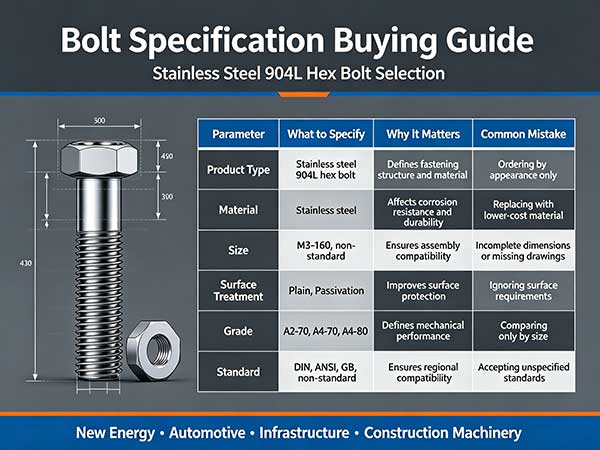
Industrial fasteners must be specified according to application conditions rather than appearance or basic dimensions alone. For stainless steel Hex bolt procurement, buyers need to define material, size range, surface treatment, strength grade, manufacturing standard, and application requirements clearly.
The verified product specification for this guide is stainless steel 904L hex bolt. The material is stainless steel, the available size range is M3-160 with non-standard customization options, the surface treatment includes Plain and Passivation, and applicable grades include A2-70, A4-70, A4-80, etc. Manufacturing standards include DIN, ANSI, GB, and non-standard requirements.
| Parameter | What to Specify | Why It Matters | Common Mistake |
|---|---|---|---|
| Product Type | Stainless steel 904L hex bolt | Defines the basic fastening structure and material requirement | Ordering based only on appearance without confirming material grade |
| Material | Stainless steel | Determines corrosion resistance, durability, and suitability for working environments | Replacing required stainless material with lower-cost alternatives |
| Size | M3-160, Non Standard | Ensures compatibility with equipment design and assembly requirements | Providing incomplete dimensions or missing non-standard drawings |
| Surface Treatment | Plain, Passivation | Affects surface protection and application performance | Ignoring surface requirements during quotation comparison |
| Grade | A2-70, A4-70, A4-80, etc. | Defines mechanical performance requirements | Comparing bolts only by size while ignoring grade differences |
| Standard | DIN, ANSI, GB, Non Standard | Ensures compatibility with regional engineering requirements | Accepting unspecified standards for critical projects |
| Application | Machinery, Chemical Industry, Environmental, Building | Helps match bolt selection with operating conditions | Using general bolts in demanding environments |
Data should be verified with current supplier quotations, certification documents, and project-specific requirements before purchase. Prices and lead times vary by specification, order volume, and market conditions at time of order.
For precision Bolt manufacturing, multi-station cold heading is an important process factor that affects dimensional consistency and material flow. A production line may use multi-stage forming operations where each station performs controlled deformation instead of completing the entire shape in one step.
The distribution of deformation volume between stations directly influences forming stability. Excessive deformation in a single station can increase internal stress, while insufficient preforming may cause incomplete filling during final forming. Buyers evaluating suppliers should ask how the manufacturer controls material flow, preform design, and tooling stress during cold heading production.
Common cold heading defects include folding, cracking, eccentric forming, and incomplete filling. These issues may result from unsuitable deformation ratios, improper lubrication, unstable raw material conditions, or incorrect die design.
Advanced suppliers commonly control these risks through processes such as:
Material condition control before forming
Pre-forming design to improve metal flow
Phosphating lubrication systems for forming stability
Finite element simulation for deformation analysis
Tooling stress evaluation during die design
For technical buyers, the key verification point is not only whether a supplier owns cold heading equipment, but whether the supplier can explain the forming sequence, defect prevention methods, and inspection approach for customized fasteners.
When sourcing High-strength fasteners, thread manufacturing after heat treatment requires careful process control. The relationship between heat treatment condition and thread rolling performance can influence fatigue resistance, dimensional stability, and long-term reliability.
Thread rolling differs from cutting because material is displaced rather than removed. This process can improve thread surface condition and create compressive residual stress at the thread root when properly controlled.
Buyers should verify whether the supplier controls:
Thread rolling pressure consistency
Thread root radius requirements
Material hardness range after treatment
Surface crack inspection procedures
Thread size recovery after forming
For demanding applications, uncontrolled rolling pressure or unsuitable material conditions may result in thread defects, dimensional variation, or reduced fatigue performance.
For technical buyers, Bolt quality verification should go beyond checking product appearance or supplier promises. A reliable procurement process requires reviewing manufacturing capability, inspection records, material information, and compliance documents that match the application requirements.
For stainless steel 904L hex bolt applications, buyers should confirm that the supplier can provide complete production information, including material identification, dimensional inspection records, mechanical performance data, and traceability documentation when required.
Material consistency is one of the most important factors when purchasing stainless steel fasteners. Different stainless steel materials may look similar but have significant differences in corrosion resistance, mechanical properties, and application suitability.
A professional supplier should maintain material traceability from raw material preparation through finished Bolt production. The traceability process normally includes:
Raw material batch identification
Production process records
Heat treatment information when applicable
Inspection results
Final product identification
For engineering projects, traceability helps buyers quickly identify production batches, analyze potential issues, and maintain quality documentation throughout the equipment lifecycle.
Precision dimensions are essential for Industrial Bolt applications. Incorrect thread dimensions, head dimensions, or overall length can create installation problems and affect assembly performance.
Professional Fastener manufacturers commonly apply multiple inspection methods during production, including:
Thread gauge inspection
Dimensional measurement tools
Visual inspection systems
Optical sorting equipment
Sampling inspection according to production requirements
Optical sorting technology can help identify appearance defects, dimensional deviations, and mixed products during high-volume manufacturing. This reduces the risk of defective fasteners entering customer supply chains.
For automotive, new energy, and infrastructure applications, buyers often need suppliers with stable production capability rather than only acceptable sample quality.
Manufacturers may use statistical process control methods to monitor production stability. Important indicators include:
| Quality Method | Purpose | Buyer Benefit |
|---|---|---|
| SPC Process Monitoring | Tracks production variation trends | Helps identify abnormal conditions before large-scale defects occur |
| Cpk/Ppk Analysis | Evaluates process capability performance | Shows whether manufacturing processes can consistently meet requirements |
| GR&R Measurement | Evaluates measurement system reliability | Confirms inspection equipment and operators provide reliable results |
When evaluating a Bolt Supplier, technical buyers should ask whether quality data is collected during production and how process deviations are managed.
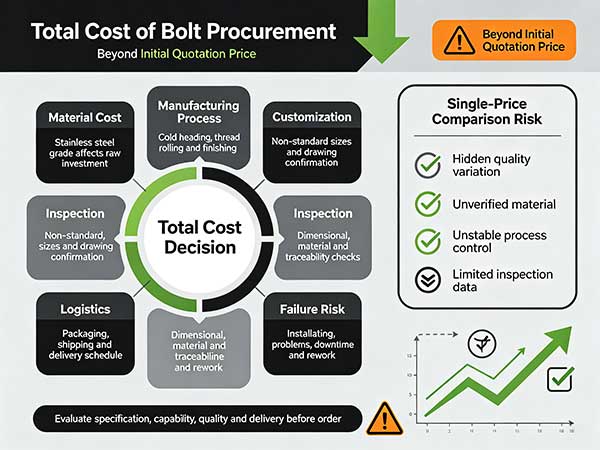
The lowest quotation is not always the lowest total cost. For industrial fasteners, purchasing decisions should consider material selection, manufacturing stability, inspection requirements, logistics, and potential failure costs.
A complete Bolt cost evaluation usually includes the following factors:
| Cost Factor | Description | Impact on Procurement |
|---|---|---|
| Material Cost | Stainless steel selection affects raw material investment | Higher performance materials may increase initial cost but improve service reliability |
| Manufacturing Process | Cold heading, thread forming, machining, and finishing requirements | Complex specifications require stronger production capability |
| Customization | Non-standard sizes and drawings require additional engineering support | Customized solutions may reduce installation problems |
| Inspection Requirements | Quality verification and documentation requirements | Critical applications may require additional inspection steps |
| Logistics | Transportation and delivery arrangements | Affects total landed cost and project scheduling |
Two Bolt suppliers may provide similar quotations while offering completely different production capabilities. A lower price may result from reduced inspection, different material sourcing, limited customization capability, or insufficient process control.
For equipment manufacturers and engineering contractors, the real procurement objective is not simply buying cheaper fasteners. The goal is obtaining stable products that meet design requirements, reduce maintenance risks, and support long-term equipment operation.
For international Bolt procurement, payment terms should be clearly confirmed before production begins. A commonly used arrangement is 30% T/T advance payment with the remaining 70% balance payment before shipment.
Buyers should confirm:
Payment schedule
Production confirmation process
Inspection timing
ShipPing documents
Final delivery requirements
Clear commercial communication helps reduce misunderstandings and supports smoother international procurement processes.
China has become an important manufacturing base for industrial fasteners because of its complete supply chain, production capabilities, and customization flexibility. However, selecting the right Bolt supplier requires more than comparing quotations. Technical buyers should evaluate manufacturing experience, process control, inspection capability, and communication efficiency.
For stainless steel 904L hex bolt sourcing, buyers should focus on whether the manufacturer can support customized requirements, maintain stable quality, and provide reliable production information throughout the purchasing process.
A qualified Bolt manufacturer should have a clear production system covering raw material management, forming processes, machining, surface treatment, inspection, and packaging.
Important supplier evaluation points include:
Experience with stainless steel fastener manufacturing
Ability to produce standard and non-standard Bolt Specifications
Stable cold heading and thread processing capability
Complete quality inspection procedures
Ability to support engineering communication
For customized fasteners, technical communication is especially important. Drawings, tolerance requirements, application conditions, and performance expectations should be confirmed before production begins.
| Evaluation Item | Questions Buyers Should Ask |
|---|---|
| Production Capability | Can the supplier manufacture required sizes and non-standard specifications? |
| Quality Control | What inspection methods are used during and after production? |
| Material Control | How is raw material identification and traceability managed? |
| Customization Support | Can engineers review drawings and recommend suitable production methods? |
| Delivery Management | How does the supplier control production schedules and shipment preparation? |
Selecting a Bolt supplier is a technical decision that affects equipment reliability and maintenance costs. Before placing an order, buyers should evaluate the supplier through detailed questions instead of relying only on product catalogs.
What stainless steel materials can you supply?
Can you manufacture non-standard Bolt sizes according to drawings?
How do you control thread quality during production?
What inspection equipment is available?
How do you manage production traceability?
How are quality issues analyzed and corrected?
Can you support long-term supply agreements?
A reliable supplier should provide clear answers supported by actual manufacturing processes rather than general statements.
For industrial applications, Ningbo yi teng construction machinery CO,LTD focuses on supplying construction machinery-related fastening solutions and supporting customized requirements according to customer specifications.
Many fastener problems are caused by incorrect purchasing decisions rather than manufacturing defects. Understanding common procurement mistakes helps buyers reduce project risks.
| Mistake | Risk | Better Approach |
|---|---|---|
| Choosing only by price | May result in unsuitable quality or unstable supply | Compare material, process capability, and inspection systems |
| Ignoring application environment | Incorrect Bolt selection may reduce service life | Consider corrosion, load, and operating conditions |
| Missing technical drawings | Creates dimensional errors during production | Provide complete specifications before quotation |
| Skipping supplier verification | Increases quality and delivery risks | Review production capability and quality controls |
| Not confirming standards | May cause assembly compatibility problems | Define DIN, ANSI, GB, or customized requirements clearly |
Before confirming a Bolt purchase order, technical buyers can use the following checklist:
✔ Confirm Bolt type and application requirements
✔ Verify material specification and grade
✔ Confirm size range and tolerance requirements
✔ Define surface treatment requirements
✔ Confirm applicable manufacturing standards
✔ Review supplier production capability
✔ Check inspection and quality documentation
✔ Confirm packaging and delivery requirements
✔ Agree payment terms and production schedule
A structured purchasing process reduces communication errors and helps ensure that the delivered fasteners meet engineering expectations.
Buyers should provide product type, material, size, grade, standard, surface treatment, quantity, application information, and technical drawings when required. Complete information helps suppliers recommend suitable production solutions.
Yes. Stainless steel fasteners can be customized according to drawings, dimensions, standards, and application requirements. Non-standard sizes should be confirmed with technical specifications before production.
Production stability directly affects dimensional accuracy, consistency, and delivery reliability. Suppliers with controlled manufacturing processes can reduce quality risks in long-term projects.
Before international procurement, buyers should confirm specifications, quality requirements, supplier capability, inspection information, packaging, shipping arrangements, and payment terms.
Choosing the right Bolt supplier requires a complete evaluation of specifications, manufacturing capability, quality management, and procurement risks. For applications in new energy, automotive, infrastructure, and construction machinery, fasteners must provide stable performance throughout the equipment lifecycle.
Technical buyers should focus on verified specifications, controlled production processes, and reliable supplier communication instead of making decisions based only on initial quotation prices.
For more information about industrial fastener solutions and related products, visit:
Contact person: Mr.Ren
Phone:0086-13958324455
Customer service: +86-0574 88065928
Email: Sales@zjbzj.com
Fax: +0086-0574 88065656

official website
Copyright @ Ningbo yi teng construction machinery CO,LTDmainly engaged in Blade Bolts Series, Hexagon bolt, and Bucket teeth. Welcome to inquire!
SitemapThis website uses cookies to ensure you get the best experience on our website.
 Español
 Portugues
 Pусский
 Français
 Deutsch
 日本語
日本語 한국어
한국어 العربية
 हिन्दी



 WhatsApp
 Phone
Phone
Comment
(0)