

bolt Manufacturing Process Guide: Cold Heading, Thread Rolling, and Quality Control for Industrial fasteners
Industrial equipment reliability depends heavily on the performance of every fastening component. A Bolt may appear simple, but its manufacturing process involves multiple engineering decisions including material selection, forming technology, thread production, heat treatment control, and inspection procedures. For technical buyers in automotive, new energy, construction machinery, and infrastructure industries, understanding the Bolt manufacturing process helps evaluate supplier capability and reduce procurement risks.
A professional Fastener manufacturer must control every production stage from raw material preparation to final inspection. Factors such as deformation ratio, material flow, thread root stress, surface condition, and dimensional accuracy directly influence the service life and reliability of Industrial Bolts.
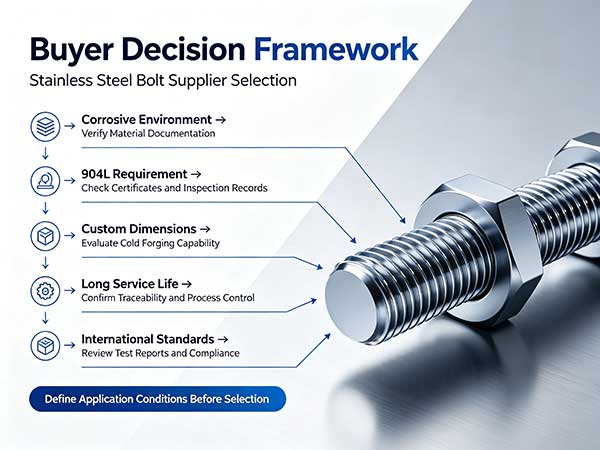
The production of industrial bolts normally includes several key stages. Each process step affects the final mechanical performance, dimensional consistency, and application reliability.
| Manufacturing Stage | Main Purpose | Quality Focus |
|---|---|---|
| Raw Material Preparation | Ensure suitable material properties before forming | Material identification and consistency |
| Cold Heading | Create Bolt head shape through controlled deformation | Material flow and forming stability |
| Thread Rolling | Produce accurate external threads | Thread profile and residual stress control |
| Surface Treatment | Improve corrosion resistance and surface performance | Uniform treatment quality |
| Inspection | Verify final product requirements | Dimensional and performance verification |
| Packaging | Protect products during storage and transportation | Identification and delivery accuracy |
Cold heading is one of the most important forming technologies used in industrial Bolt manufacturing. Instead of removing material through machining, cold heading reshapes metal through controlled pressure and deformation.
The advantages of cold heading include efficient material utilization, high production efficiency, and improved mechanical consistency. However, successful cold heading requires precise control of tooling design, material flow, and deformation distribution.
For complex Bolt structures, multi-station cold heading machines divide the forming operation into several controlled steps. Each station performs a specific deformation task, allowing manufacturers to gradually shape the Bolt head while reducing stress concentration.
A typical multi-station process may include:
Material cutting and preparation
Initial forming operation
Intermediate pre-forming
Final head forming
Dimensional correction
The advantage of multiple forming stations is better control of metal movement. When deformation is distributed correctly, manufacturers can reduce defects such as cracking, folding, and incomplete filling.
Material flow is a critical factor affecting Bolt quality. During cold heading, metal must move evenly inside the die cavity to achieve complete filling without excessive stress concentration.
Poor material flow planning may cause:
Uneven head formation
Surface folding defects
Internal stress concentration
Dimensional instability
Professional manufacturers analyze deformation behavior before production through tooling experience and engineering simulation methods. Proper pre-form design helps achieve stable forming results while extending tool life.
Deformation ratio refers to the amount of material deformation during each forming stage. Excessive deformation in one operation increases the risk of cracks, while insufficient deformation may cause incomplete filling.
Effective deformation control requires:
Suitable forming sequence design
Correct die geometry
Stable lubrication conditions
Consistent raw material properties
Continuous process monitoring
For customized Bolt production, deformation analysis is especially important because non-standard dimensions may require different forming strategies compared with standard fasteners.
During Bolt production, forming defects can affect strength, appearance, and assembly performance. Understanding these defects helps buyers evaluate supplier quality control capability.
| Defect | Possible Cause | Prevention Method |
|---|---|---|
| Folding | Incorrect material flow or die design | Optimize forming sequence and tooling structure |
| Cracking | Excessive deformation or unsuitable material condition | Control deformation ratio and material quality |
| Incomplete Filling | Insufficient forming pressure or improper design | Improve die cavity design and process parameters |
| Dimensional Variation | Tool wear or unstable production conditions | Apply process monitoring and inspection systems |
Thread manufacturing is a critical stage in Bolt production because threads directly transfer load between assembled components. For industrial applications, thread accuracy, surface condition, and fatigue performance are key factors affecting long-term reliability.
Thread rolling is widely used for high-performance fasteners because it forms threads through material displacement rather than cutting away material. This process can improve thread surface quality and create beneficial residual stress conditions when properly controlled.
| Feature | Thread Rolling | Thread Cutting |
|---|---|---|
| Material Processing | Forms threads through plastic deformation | Removes material through cutting |
| Surface Condition | Creates smoother thread surfaces | May create machining marks |
| Fatigue Performance | Can improve fatigue resistance through residual stress | May reduce surface strength if not controlled properly |
| Production Efficiency | Suitable for high-volume manufacturing | More suitable for certain customized machining requirements |
For demanding applications such as automotive equipment, construction machinery, and energy systems, thread rolling provides advantages when the process parameters are carefully controlled.
The thread root is one of the most critical areas in a Bolt because stress concentration often occurs at this location during repeated loading conditions. Proper thread rolling can introduce compressive residual stress at the thread root, improving resistance to fatigue failure.
However, the benefits depend on manufacturing control. Excessive rolling pressure, incorrect tooling, or unsuitable material conditions may create dimensional problems or surface damage.
Technical buyers evaluating a Bolt Supplier should consider whether the manufacturer controls:
Thread rolling pressure
Thread profile accuracy
Rolling tool condition
Thread root geometry
Surface defect inspection
For High-strength fasteners, heat treatment plays an important role in achieving required mechanical properties. The process affects hardness, toughness, internal stress distribution, and overall service performance.
A stable heat treatment process requires accurate control of heating temperature, holding time, cooling method, and process monitoring.
| Factor | Purpose | Potential Risk Without Control |
|---|---|---|
| Heating Temperature | Achieve required material transformation | Unstable mechanical properties |
| Holding Time | Ensure uniform treatment | Uneven hardness distribution |
| Cooling Process | Control final material condition | Excessive stress or insufficient strength |
| Hardness Testing | Verify treatment results | Product inconsistency |
Decarburization occurs when carbon content near the surface of steel decreases during heat treatment. This can reduce surface hardness and negatively affect fatigue performance in certain high-strength bolt applications.
Manufacturers control decarburization through:
Controlled furnace atmosphere
Suitable heating parameters
Process monitoring
Surface hardness verification
For technical procurement, buyers should understand whether the supplier monitors heat treatment quality and performs necessary inspections according to product requirements.
Hardness distribution inside a Bolt can influence performance under different loading conditions. A suitable hardness gradient provides a balance between strength and toughness.
A professional manufacturing process should avoid excessive hardness variation between different areas of the Bolt. Stable hardness control helps improve reliability in applications involving vibration, impact, or repeated loading.
Quality control is not limited to final inspection. A reliable Bolt Manufacturer applies inspection throughout the production process to identify and prevent potential problems before shipment.
Eddy current inspection is a non-destructive testing method that can detect certain surface and near-surface defects without damaging the product.
This inspection method can help identify:
Surface cracks
Material discontinuities
Production-related defects
Abnormal surface conditions
For critical applications, combining production monitoring with inspection technology helps improve supply reliability.
Statistical Process Control (SPC) helps manufacturers monitor production stability by analyzing process data over time.
SPC can be applied to:
Dimensional measurements
Thread parameters
Hardness results
Production variation trends
The purpose of SPC is not only to identify defective products but also to detect process changes before defects occur.
Process capability analysis helps determine whether a manufacturing process can consistently meet technical requirements.
| Method | Function |
|---|---|
| Cpk/Ppk | Evaluates process capability and production consistency |
| GR&R | Evaluates measurement system reliability |
These quality methods provide technical buyers with better confidence when selecting long-term Bolt suppliers.
For high-volume Bolt production, manual inspection alone may not provide sufficient efficiency and consistency. Optical sorting technology provides an automated solution for identifying dimensional variations, surface defects, and product mixing risks before shipment.
Optical sorting systems use cameras, sensors, and image processing technology to inspect fasteners at high speed. This allows manufacturers to improve inspection efficiency while reducing the possibility of defective products entering customer supply chains.
| Inspection Item | Purpose | Buyer Benefit |
|---|---|---|
| Appearance Inspection | Identify visible surface defects | Reduces quality risks during assembly |
| Dimension Verification | Check critical measurements | Improves installation compatibility |
| Product Sorting | Separate qualified and defective products | Improves shipment accuracy |
| Batch Control | Support production traceability | Helps manage quality records |
For technical buyers, optical sorting capability demonstrates that a Bolt supplier has invested in production reliability and quality consistency, especially for large-volume industrial applications.
Traceability is becoming increasingly important in automotive, new energy, and infrastructure projects. When fasteners are used in critical equipment, buyers need confidence that every batch can be identified and verified.
A complete Bolt traceability system may include:
Raw material batch records
Production date information
Manufacturing process records
Inspection results
Packaging identification
Traceability allows manufacturers and customers to quickly analyze potential issues, improve corrective actions, and maintain consistent quality throughout long-term supply relationships.
Choosing a Bolt supplier requires evaluating more than product samples. Technical buyers should review whether the manufacturer has the engineering capability, equipment, and quality systems required for long-term cooperation.
| Evaluation Area | Questions to Consider |
|---|---|
| Engineering Capability | Can the supplier analyze drawings and recommend suitable production methods? |
| Forming Technology | Does the manufacturer control cold heading parameters and tooling design? |
| Thread Production | How does the supplier verify thread accuracy and performance? |
| Quality Management | Are SPC, inspection records, and traceability systems applied? |
| Customization Ability | Can the supplier support non-standard Bolt requirements? |
A capable manufacturer should be able to explain not only what equipment is available but also how each process step contributes to final Bolt performance.
Understanding common production problems helps buyers communicate better with suppliers and avoid unexpected quality issues.
| Problem | Possible Cause | Prevention Method |
|---|---|---|
| Thread Damage | Improper rolling parameters or tooling wear | Regular tooling inspection and thread measurement |
| Surface Cracks | Material problems or excessive forming stress | Control material quality and deformation ratio |
| Hardness Variation | Unstable heat treatment conditions | Monitor temperature and verify hardness results |
| Mixed Products | Insufficient sorting control | Use automated inspection and identification systems |
Before selecting a Bolt supplier, buyers can use this checklist to confirm important technical and commercial requirements.
Confirm required Bolt material and grade
Verify dimensions and applicable standards
Confirm surface treatment requirements
Review manufacturing process capability
Check cold heading and thread rolling experience
Confirm inspection methods and quality records
Verify traceability management
Review customization capability
Confirm production schedule and delivery requirements
Agree payment terms before production
Cold heading improves production efficiency and material utilization by forming Bolt structures through controlled deformation. Proper process design also helps maintain consistent mechanical performance.
Thread rolling can improve thread surface quality and may enhance fatigue performance through favorable residual stress conditions when properly controlled.
Buyers should review inspection records, dimensional verification, material information, traceability documentation, and supplier quality management processes.
A stable manufacturing process reduces the risk of dimensional errors, inconsistent performance, and supply interruptions, helPing ensure reliable equipment operation.
The performance of an industrial Bolt depends on every stage of manufacturing, from material preparation and cold heading to thread rolling, heat treatment, inspection, and final packaging.
For technical buyers, selecting a supplier with strong process control, quality management capability, and customization experience is essential for reducing operational risks and improving long-term equipment reliability.
A professional Bolt sourcing strategy should focus on engineering requirements, verified manufacturing capability, and consistent quality performance rather than selecting suppliers only by price.
For more information about industrial fastener solutions and related products, visit:
Contact person: Mr.Ren
Phone:0086-13958324455
Customer service: +86-0574 88065928
Email: Sales@zjbzj.com
Fax: +0086-0574 88065656

official website
Copyright @ Ningbo yi teng construction machinery CO,LTDmainly engaged in Blade Bolts Series, Hexagon bolt, and Bucket teeth. Welcome to inquire!
SitemapThis website uses cookies to ensure you get the best experience on our website.
 Español
 Portugues
 Pусский
 Français
 Deutsch
 日本語
日本語 한국어
한국어 العربية
 हिन्दी



 WhatsApp
 Phone
Phone
Comment
(0)