

How to Choose the Right bolt for Construction Machinery and Heavy Equipment Applications
Construction machinery operates under some of the most demanding working conditions in industrial environments. Excavators, loaders, mining equipment, and heavy-duty machines experience continuous vibration, impact loads, changing temperatures, and complex mechanical stress. Selecting the correct Bolt is essential for maintaining equipment safety, reducing downtime, and extending service life.
For technical buyers, choosing a Bolt is not simply a matter of matching diameter and length. A complete selection process requires evaluating material, grade, standard, thread design, application environment, manufacturing quality, and supplier capability. Incorrect fastener selection may lead to loosening, fatigue failure, unexpected maintenance costs, and production interruptions.
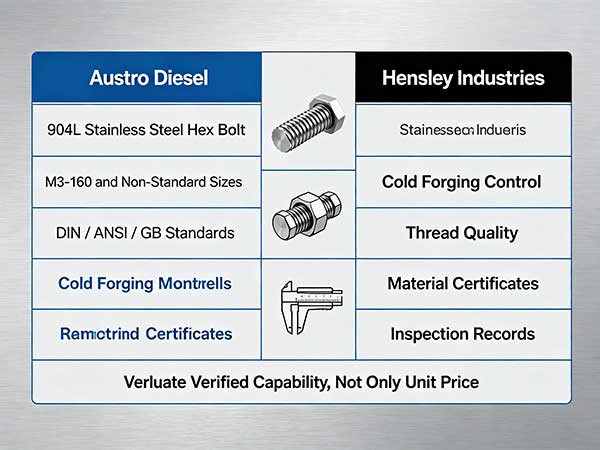
bolts used in construction machinery must maintain reliable clamPing force under severe operating conditions. Heavy equipment often experiences repeated dynamic loading, vibration, and impact forces that can gradually affect fastening performance.
A properly selected Bolt helps achieve:
Stable connection between mechanical components
Resistance against vibration-induced loosening
Reliable performance under repeated loading
Longer equipment maintenance intervals
Improved operational safety
For equipment manufacturers and maintenance teams, fastener selection should be considered part of the overall engineering design rather than a simple purchasing decision.
Before purchasing Bolts for construction machinery, buyers should define technical requirements clearly. A complete specification prevents incorrect quotations and reduces communication problems between customers and suppliers.
| Specification Factor | Description | Importance |
|---|---|---|
| Material | Determines corrosion resistance and mechanical performance | Ensures suitability for operating conditions |
| Size | Includes diameter, length, and thread dimensions | Ensures proper equipment assembly |
| Grade | Defines strength and mechanical characteristics | Matches load requirements |
| Standard | DIN, ANSI, GB, or customized specifications | Ensures compatibility with engineering requirements |
| Surface Treatment | Provides additional surface protection | Improves durability in specific environments |
Construction machinery creates complex loading conditions that include tension, shear force, vibration, and impact stress. A Bolt selected only according to physical dimensions may not provide sufficient performance if the actual operating conditions are not considered.
Tensile loads attempt to separate connected components. The Bolt must maintain sufficient clamping force to keep the assembly secure during operation.
Important factors include:
Bolt strength grade
Material properties
Thread engagement length
Installation torque requirements
Heavy machinery components may experience lateral forces caused by movement, vibration, and mechanical impact. In these conditions, the Bolt must resist shear stress while maintaining joint stability.
Applications such as bucket assemblies, Structural connections, and machinery frames require careful evaluation of fastening performance under repeated mechanical loading.
Material selection directly affects Bolt performance, especially in environments involving moisture, chemicals, temperature variation, or outdoor exposure.
Stainless Steel Bolts are often selected for applications requiring improved corrosion resistance. Stainless steel 904L Hex bolt products provide high corrosion resistance characteristics and can be customized according to specific engineering requirements.
Available specifications may include:
Material: Stainless steel
Size range: M3-160, Non Standard
Surface treatment: Plain, Passivation
Grades: A2-70, A4-70, A4-80, etc.
Standards: DIN, ANSI, GB, Non Standard
| Working Environment | Selection Consideration |
|---|---|
| Outdoor Construction Sites | Consider corrosion resistance and surface protection |
| Mining Equipment | Consider vibration and impact resistance |
| Chemical Environments | Consider material compatibility |
| Heavy Machinery Systems | Consider mechanical strength and durability |
Thread quality directly affects Bolt installation reliability. Poor thread accuracy may cause assembly difficulties, uneven loading, or reduced fastening performance.
Professional Bolt manufacturing uses controlled thread forming processes to achieve consistent thread dimensions and surface quality.
Improved thread surface quality
Better dimensional consistency
Reduced risk of thread damage
Improved fatigue resistance
Understanding Bolt failure modes helps technical buyers select suitable fasteners and improve equipment reliability. In construction machinery, failures are rarely caused by a single factor. They usually result from a combination of incorrect specification, unsuitable installation, excessive loading, or insufficient manufacturing control.
Common Bolt failure problems include:
| Failure Type | Possible Cause | Prevention Method |
|---|---|---|
| Fatigue Failure | Repeated loading and vibration over long operating periods | Select suitable Bolt grades and control thread quality |
| Loosening | Insufficient preload or continuous vibration | Optimize installation process and joint design |
| Thread Damage | Incorrect engagement or poor thread manufacturing | Use accurate thread forming and inspection |
| Corrosion Damage | Exposure to moisture or aggressive environments | Select appropriate materials and surface treatments |
| Cracking | Excessive stress or manufacturing defects | Control forming processes and material quality |
Heavy machinery often operates under repeated loading conditions. Each operating cycle creates stress changes inside fastening components. Over time, these repeated stresses may initiate fatigue damage if the Bolt design or manufacturing quality is insufficient.
Important factors affecting Bolt fatigue performance include:
Thread root geometry
Surface condition
Residual stress distribution
Material consistency
Installation preload
Thread rolling technology can improve fatigue performance by creating a smoother thread surface and favorable residual stress conditions when properly controlled.
Vibration is one of the biggest challenges affecting fasteners used in construction machinery. Excavators, loaders, drilling equipment, and mining machines generate continuous mechanical vibration that can gradually reduce joint stability.
To improve vibration resistance, engineers should consider the complete fastening system rather than only the Bolt itself.
| Factor | Impact on Fastening Performance |
|---|---|
| Preload Force | Maintains clamping force between connected components |
| Thread Accuracy | Ensures stable load distribution |
| Material Selection | Affects strength and durability under vibration |
| Assembly Method | Influences final joint reliability |
Even a high-quality Bolt may fail if installation procedures are incorrect. Over-tightening can create excessive stress, while insufficient tightening may result in loosening during operation.
Technical teams should control:
Recommended tightening torque
Installation tools
Assembly procedures
Inspection methods after installation
For construction machinery applications, supplier manufacturing capability directly affects product reliability. Buyers should evaluate whether the manufacturer has effective control systems throughout the production process.
Cold heading influences the final Bolt shape, material flow, and dimensional consistency. Poor forming control may create hidden defects that affect long-term performance.
Important control points include:
Material preparation
Multi-station forming sequence
Deformation ratio management
Tooling condition monitoring
Defect prevention procedures
Thread rolling requires accurate control of forming pressure, tooling condition, and thread dimensions. A stable thread manufacturing process helps improve assembly consistency and load transfer capability.
Quality checks may include:
Thread gauge inspection
Dimensional measurement
Surface defect detection
Thread profile verification
For applications requiring enhanced mechanical performance, heat treatment quality must be controlled carefully. Important verification items include hardness testing, process records, and material performance evaluation.
Manufacturers should monitor:
Heating conditions
Cooling processes
Hardness distribution
Potential decarburization risks
A reliable Bolt Supplier applies inspection methods throughout manufacturing instead of relying only on final product checking.
| Inspection Method | Purpose |
|---|---|
| Dimensional Inspection | Verify size accuracy and assembly compatibility |
| Thread Inspection | Confirm thread quality and fit performance |
| Hardness Testing | Verify heat treatment results |
| Eddy Current Inspection | Detect certain surface and near-surface defects |
| Optical Sorting | Improve high-volume inspection efficiency |
Supplier selection is a key step in construction machinery Fastener Procurement. A supplier should demonstrate not only manufacturing capacity but also engineering understanding and quality management ability.
Can the supplier provide customized Bolt solutions?
Does the supplier understand heavy equipment applications?
Are production processes clearly controlled?
Are inspection records available?
Can the supplier support long-term supply requirements?
China has developed a complete industrial Fastener Supply Chain with advanced manufacturing equipment, flexible customization capability, and extensive experience serving global machinery industries. For construction machinery manufacturers and engineering companies, sourcing Bolt products from China can provide access to customized solutions and competitive manufacturing resources.
However, successful international procurement requires careful supplier evaluation. Technical buyers should focus on manufacturing capability, quality control systems, communication efficiency, and long-term supply reliability rather than selecting suppliers only based on quotation prices.
| Evaluation Factor | What Buyers Should Confirm |
|---|---|
| Manufacturing Experience | Experience producing industrial fasteners for machinery applications |
| Customization Capability | Ability to manufacture non-standard Bolt specifications |
| Quality System | Inspection procedures, traceability, and process monitoring |
| Technical Support | Ability to review drawings and recommend suitable solutions |
| Delivery Management | Stable production scheduling and shipment coordination |
Construction machinery manufacturers often require fasteners that match specific equipment designs. Standard catalog products may not always meet special requirements related to dimensions, materials, thread specifications, or installation conditions.
Customized Bolt solutions can help manufacturers achieve:
Better equipment compatibility
Improved assembly efficiency
Reduced modification requirements
Optimized fastening performance
Long-term supply consistency
When requesting customized Bolts, buyers should provide detailed technical information including drawings, dimensions, standards, operating environment, and expected performance requirements.
The purchase cost of a Bolt is only one part of the total procurement cost. For heavy equipment manufacturers, product reliability, maintenance requirements, and supply stability can have a greater impact on overall project costs.
| Cost Element | Procurement Consideration |
|---|---|
| Material Selection | Higher-performance materials may improve service life |
| Manufacturing Quality | Stable production reduces replacement and maintenance risks |
| Inspection Requirements | Additional verification may be needed for critical applications |
| Delivery Reliability | Stable supply prevents project delays |
| Failure Risk | Incorrect fasteners may create expensive downtime |
A lower quotation may appear attractive but can create hidden risks if the supplier reduces material quality, inspection procedures, or process control. For heavy machinery applications, a fastener failure may cause equipment downtime, safety concerns, and additional repair costs.
A professional purchasing strategy evaluates the complete value of the Bolt solution, including product reliability, technical support, and supplier capability.
Many fastener-related problems occur because of incomplete specifications or insufficient supplier evaluation before ordering.
| Procurement Mistake | Potential Result | Recommended Solution |
|---|---|---|
| Choosing only by price | Higher risk of quality problems | Evaluate manufacturing capability and quality systems |
| Ignoring operating conditions | Incorrect material or grade selection | Consider load, vibration, and environment |
| Using incomplete specifications | Wrong product delivery | Provide drawings and technical requirements |
| Skipping supplier verification | Unstable quality and delivery issues | Review production and inspection capability |
| Ignoring traceability | Difficult problem analysis | Select suppliers with production records |
Before confirming a Bolt order, technical buyers should review the following points:
✔ Confirm Bolt application and equipment requirements
✔ Verify material and mechanical grade
✔ Confirm dimensions and thread specifications
✔ Define required standards such as DIN, ANSI, or GB
✔ Confirm surface treatment requirements
✔ Review supplier manufacturing capability
✔ Verify quality inspection methods
✔ Confirm customization requirements
✔ Agree production schedule and delivery terms
✔ Confirm payment conditions before production
The suitable Bolt depends on equipment design, load conditions, environmental exposure, and required mechanical performance. Buyers should select fasteners according to engineering specifications rather than size alone.
Heavy equipment operates under vibration, impact, and repeated loading. Stable manufacturing processes help ensure thaT Bolts maintain reliable performance during long-term operation.
Yes. Many industrial Fastener manufacturers support customized Bolt production according to drawings, dimensions, standards, and application requirements.
Buyers can reduce risks by selecting suitable materials, verifying supplier capability, reviewing inspection procedures, and ensuring correct installation practices.
Construction machinery requires fastening solutions that can withstand vibration, impact, and demanding operating environments. Selecting the correct Bolt involves evaluating specifications, material performance, manufacturing quality, and supplier capability.
For technical buyers, the best procurement decision is not based only on initial price. A reliable Bolt supplier should provide stable quality, customized support, controlled manufacturing processes, and consistent delivery performance.
By applying a structured selection process, equipment manufacturers can reduce maintenance risks, improve machine reliability, and achieve better long-term operating results.
For more information about industrial fastener products and related solutions, visit:
Contact person: Mr.Ren
Phone:0086-13958324455
Customer service: +86-0574 88065928
Email: Sales@zjbzj.com
Fax: +0086-0574 88065656

official website
Copyright @ Ningbo yi teng construction machinery CO,LTDmainly engaged in Blade Bolts Series, Hexagon bolt, and Bucket teeth. Welcome to inquire!
SitemapThis website uses cookies to ensure you get the best experience on our website.
 Español
 Portugues
 Pусский
 Français
 Deutsch
 日本語
日本語 한국어
한국어 العربية
 हिन्दी



 WhatsApp
 Phone
Phone
Comment
(0)