

High Strength bolt Guide: Grades, Mechanical Properties, Applications, and Failure Prevention
high strength Bolts are essential fastening components used in applications where ordinary fasteners cannot provide sufficient load capacity, fatigue resistance, or structural reliability. Industries such as construction, automotive manufacturing, energy systems, mining equipment, and heavy machinery depend on high-performance bolts to maintain safe and stable connections under demanding conditions.
Selecting the correct high strength Bolt requires understanding more than tensile strength. Technical buyers must evaluate Bolt grades, material properties, manufacturing processes, installation requirements, and application environments. An unsuitable fastener can lead to joint failure, equipment downtime, and increased maintenance costs.
This guide explains the key factors involved in high strength Bolt selection, including mechanical properties, production technology, application requirements, quality control, and supplier evaluation.
A high strength Bolt is a fastener designed to withstand higher mechanical loads compared with standard Bolts. These products typically use carefully selected materials and controlled manufacturing processes to achieve improved tensile strength, fatigue resistance, and durability.
High Strength Bolts are commonly used where fastening systems must maintain performance under:
High tensile loads
Repeated vibration
Heavy mechanical stress
Impact forces
Extreme operating environments
Modern industrial equipment requires fastening solutions that provide stable performance throughout the entire service lifecycle. As machinery becomes more powerful and structures become more complex, fastening requirements continue to increase.
High strength Bolts provide advantages including:
Higher load-bearing capability
Improved joint stability
Better resistance to fatigue damage
Reduced risk of connection failure
Longer service intervals
Bolt grades define important mechanical characteristics such as tensile strength and yield strength. Selecting the correct grade ensures that the fastener matches the requirements of the application.
| Bolt Grade Category | Main Characteristics | Typical Application |
|---|---|---|
| Medium Strength Bolt | Suitable for general mechanical fastening | Standard industrial equipment |
| High Strength Bolt | Higher tensile and load capacity | Heavy machinery and structural applications |
| Ultra High Performance Bolt | Designed for extreme loading conditions | Special engineering applications |
Mechanical performance is one of the most important factors when selecting high strength Bolts. The fastener must maintain sufficient strength while avoiding brittleness and premature failure.
Tensile strength refers to the maximum pulling force a Bolt can withstand before failure. High tensile strength allows Bolts to support greater loads in demanding applications.
Applications requiring high tensile performance include:
Heavy equipment structures
Industrial machinery assemblies
Transportation systems
Large Mechanical connections
Yield strength represents the stress level at which permanent deformation begins. A suitable yield strength ensures that the Bolt maintains its original shape during normal operation.
For engineering applications, selecting a Bolt with appropriate yield strength helps prevent deformation-related failures.
Many Industrial Bolts operate under repeated loading conditions. Fatigue resistance determines how well a fastener performs during long-term cyclic stress.
Factors affecting fatigue performance include:
Thread design
Surface condition
Material quality
Manufacturing accuracy
Installation preload
Material selection directly influences Bolt performance. Manufacturers choose materials according to strength requirements, environmental conditions, and application standards.
| Material Type | Characteristics | Application Consideration |
|---|---|---|
| Carbon Steel | Good strength and cost efficiency | General industrial applications |
| Alloy Steel | Improved mechanical performance | High-load applications |
| Stainless Steel | Strong corrosion resistance | Outdoor and demanding environments |
The performance of a high strength Bolt depends heavily on manufacturing quality. Professional production requires precise control throughout forming, thread processing, heat treatment, and inspection.
Cold heading forms the Bolt shape through controlled material deformation. This process improves production efficiency and maintains material consistency when properly managed.
Important control factors include:
Raw material quality
Forming sequence design
Tooling condition
Deformation control
Thread rolling creates threads through material displacement instead of cutting. This process helps improve thread surface quality and may enhance fatigue resistance.
Quality thread production requires control of:
Thread dimensions
Rolling pressure
Tool condition
Surface quality
Heat treatment is a critical manufacturing stage that determines the final mechanical performance of high strength Bolts. Through controlled heating and cooling processes, manufacturers can improve hardness, strength, toughness, and overall durability.
An effective heat treatment process helps high strength Bolts achieve a balanced combination of strength and reliability. Incorrect treatment conditions may result in excessive hardness, insufficient toughness, or unstable mechanical properties.
| Process | Purpose | Performance Impact |
|---|---|---|
| Quenching | Increase material hardness and strength | Improves load-bearing capability |
| Tempering | Reduce brittleness after hardening | Improves toughness and reliability |
| Stress Relief | Reduce internal manufacturing stress | Improves dimensional stability |
Hardness is an important indicator for evaluating high strength Bolt performance. It reflects the material condition after heat treatment and helps confirm whether the product meets technical requirements.
Manufacturers typically control:
Surface hardness
Core hardness
Hardness distribution
Batch consistency
Stable hardness control helps prevent problems such as premature cracking, deformation, or inconsistent mechanical performance.
During heat treatment, carbon loss near the Bolt surface may reduce hardness and negatively affect fatigue performance. Therefore, controlling decarburization is an important part of high strength Bolt manufacturing.
Effective prevention methods include:
Controlled furnace atmosphere
Optimized heating parameters
Regular process monitoring
Surface hardness inspection
High strength Bolts are widely used across industries where fastening reliability directly affects equipment safety and operational performance.
In steel structures, bridges, and large industrial buildings, Bolts must maintain strong connections under static and dynamic loads.
Important requirements include:
High tensile capacity
Stable preload performance
Reliable installation accuracy
Long-term structural durability
Heavy machinery such as excavators, mining equipment, and loaders operate under continuous vibration and impact forces. High strength Bolts help maintain stable connections between critical components.
Common application areas include:
Machine frames
Bucket assemblies
Hydraulic system connections
Heavy-duty mechanical joints
Automotive manufacturers use high strength Bolts in components requiring reliable mechanical connections and weight optimization.
Key requirements include:
High strength-to-weight ratio
Fatigue resistance
Dimensional accuracy
Consistent production quality
Power generation equipment, renewable energy systems, and industrial electrical infrastructure require fastening components that can withstand long-term operation.
High strength Bolts help improve:
Equipment stability
Connection reliability
Maintenance efficiency
Operational safety
Proper installation is essential for achieving the designed performance of high strength Bolts. Even premium-quality fasteners may fail if incorrect tightening procedures are used.
Preload force creates the clamPing pressure required to maintain joint stability. Proper preload helps prevent movement between connected components and reduces the risk of loosening.
Factors affecting preload include:
Tightening torque
Thread friction
Surface condition
Lubrication condition
Installation method
| Problem | Possible Result | Prevention Method |
|---|---|---|
| Insufficient Tightening | Joint loosening during operation | Control torque requirements |
| Over Tightening | Excessive stress or Bolt damage | Follow specified installation procedures |
| Incorrect Tools | Unstable fastening performance | Use calibrated equipment |
| Improper Lubrication | Torque variation | Control assembly conditions |
Preventing Bolt failure requires cooperation between engineering design, manufacturing quality, and correct installation practices.
Effective prevention strategies include:
Select suitable Bolt grades according to application requirements
Use reliable manufacturing processes
Control thread quality and surface condition
Verify heat treatment performance
Apply correct installation methods
Perform regular equipment inspections
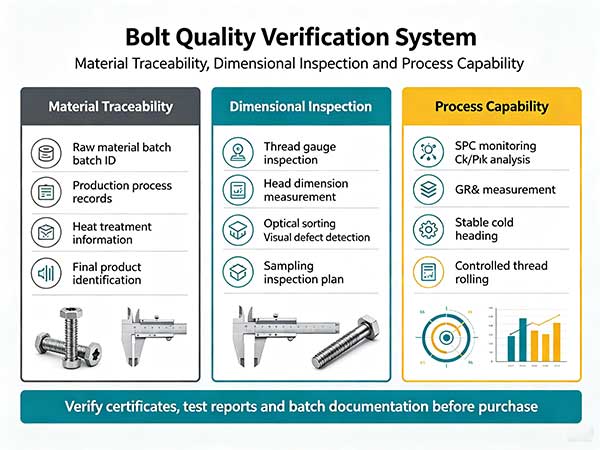
A complete quality inspection system ensures that high strength Bolts meet performance expectations before delivery.
| Inspection Method | Purpose |
|---|---|
| Dimensional Testing | Verify size and tolerance accuracy |
| Mechanical Testing | Confirm tensile and yield performance |
| Hardness Testing | Verify heat treatment results |
| Thread Inspection | Ensure assembly compatibility |
| Surface Inspection | Identify visible defects |
Selecting the right high strength Bolt supplier is essential for ensuring product reliability, stable production, and long-term supply capability. A qualified supplier should provide not only competitive pricing but also strong engineering support, manufacturing control, and consistent quality management.
Technical buyers should evaluate suppliers based on multiple factors rather than price alone.
| Evaluation Area | Key Questions |
|---|---|
| Manufacturing Experience | Does the supplier have experience producing high strength Bolts? |
| Technical Capability | Can the supplier support custom designs and engineering requirements? |
| Production Equipment | Are forming, thread rolling, and heat treatment capabilities available? |
| Quality Management | Are inspection systems and traceability processes established? |
| Delivery Capability | Can the supplier maintain stable production schedules? |
Different industries often require customized fastening solutions due to unique equipment structures, installation conditions, and performance requirements.
Professional high strength Bolt Manufacturers can provide customized solutions including:
Non-standard dimensions
Special thread specifications
Customized materials
Special surface treatments
Application-specific designs
When requesting customized Bolts, buyers should provide complete technical information, including drawings, material requirements, standards, quantity, and working environment.
The purchasing cost of high strength Bolts includes more than the product unit price. A complete evaluation should consider quality consistency, service life, maintenance requirements, and supply reliability.
| Cost Factor | Influence on Procurement |
|---|---|
| Material Selection | Determines strength, durability, and application suitability |
| Manufacturing Process | Affects product consistency and performance stability |
| Quality Inspection | Reduces the risk of defective products entering production |
| Delivery Reliability | Prevents project delays caused by supply interruptions |
| Service Life | Influences long-term maintenance expenses |
A lower purchase price may create additional risks if product quality or manufacturing control is insufficient. For critical industrial applications, Bolt failure can result in equipment damage, production interruption, and increased repair costs.
A reliable procurement strategy focuses on overall value, including performance stability, supplier capability, and long-term cooperation potential.
Many fastening problems can be avoided by improving the purchasing process and evaluating technical requirements before ordering.
| Common Mistake | Potential Risk | Recommended Action |
|---|---|---|
| Selecting Only by Price | Possible quality and reliability issues | Evaluate complete supplier capability |
| Ignoring Application Conditions | Incorrect Bolt selection | Analyze loads, vibration, and environment |
| Using Incomplete Specifications | Wrong product delivery | Provide detailed technical information |
| Ignoring Installation Requirements | Reduced fastening performance | Follow recommended tightening procedures |
| Skipping Quality Verification | Higher failure risk | Review inspection documentation |
Before confirming a high strength Bolt order, buyers should verify the following information:
✔ Required Bolt grade and strength level
✔ Material specification
✔ Bolt dimensions and thread type
✔ Applicable standards
✔ Surface treatment requirements
✔ Operating temperature and environment
✔ Load and vibration conditions
✔ Required inspection documents
✔ Production lead time
✔ Supplier quality management capability
A high strength Bolt is designed with enhanced mechanical properties, including higher tensile strength and improved load-bearing capability, allowing it to perform under demanding industrial conditions.
Yes. High strength Bolts are widely used in heavy machinery because they can withstand vibration, impact forces, and repeated mechanical loading.
Heat treatment changes the internal structure of the material, improving strength, hardness, and toughness when properly controlled.
Thread quality directly affects load distribution, installation accuracy, and fatigue resistance. Poor thread quality may reduce fastening reliability.
Yes. Manufacturers can provide customized high strength Bolt solutions based on customer drawings, dimensions, materials, and application requirements.
High strength Bolts play a critical role in maintaining safe and reliable connections in demanding industrial applications. Proper selection requires careful evaluation of mechanical properties, materials, manufacturing processes, installation methods, and supplier capability.
For construction, automotive, energy, mining, and heavy equipment industries, choosing a reliable Bolt solution helps reduce maintenance risks, improve equipment performance, and extend service life.
A professional sourcing approach should focus on quality consistency, technical support, and long-term value. By selecting the right high strength Bolt manufacturer, companies can achieve safer operations and more reliable engineering performance.
For more industrial fastener solutions and customized Bolt products, visit:
Contact person: Mr.Ren
Phone:0086-13958324455
Customer service: +86-0574 88065928
Email: Sales@zjbzj.com
Fax: +0086-0574 88065656

official website
Copyright @ Ningbo yi teng construction machinery CO,LTDmainly engaged in Blade Bolts Series, Hexagon bolt, and Bucket teeth. Welcome to inquire!
SitemapThis website uses cookies to ensure you get the best experience on our website.
 Español
 Portugues
 Pусский
 Français
 Deutsch
 日本語
日本語 한국어
한국어 العربية
 हिन्दी



 WhatsApp
 Phone
Phone
Comment
(0)